Aug 18, 2026Buying Guides
More Functions or Better Comfort? What Matters in an EMS Eye Massager
Does an EMS eye massager need more LED colors and functions? Learn why comfort, targeted features and consistent use matter when developing an under-eye beauty device.
More Functions or Better Comfort? What Matters in an EMS Eye Massager
When beauty brands compare home-use eye care devices, the first comparison often looks simple:
How many functions does each device have?
One product may offer red, blue and green LED light, vibration massage and microcurrent. Another may focus on only red light and EMS microcurrent.
At first glance, the device with more functions may appear to offer better value.
But for an under-eye beauty device, is a longer feature list really what determines the better product?
A recent discussion with one of our European customers raised exactly this question.
A Real Buyer Question: “Your Competitor Has More Functions and a Lower Price”
During the evaluation of our EMS eye care device, a customer compared it with products from several other manufacturers.
The competing product offered:
- Red, blue and green LED light
- Vibration massage
- Microcurrent
- A lower purchase price
Our device had a more focused configuration built around:
- Red light
- EMS microcurrent
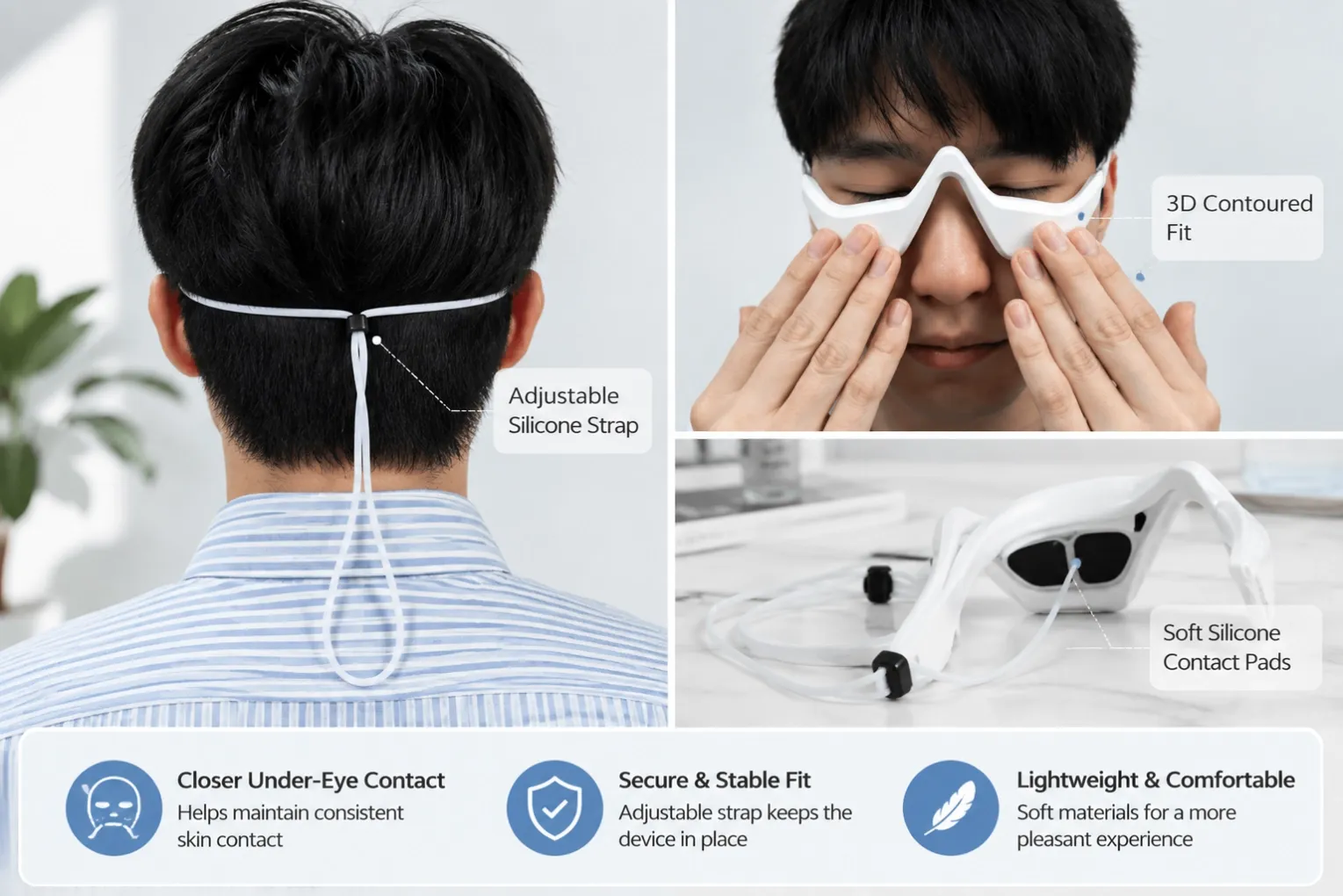
- Ergonomic under-eye contact
- Comfort-oriented wearing design
The buyer therefore asked a very reasonable question:
“The competitor offers more functions at a lower price. Why is your device more expensive?”
Instead of simply adding more functions to win the specification comparison, we looked at a different question:
Which functions actually make sense for the under-eye area?
1. More LED Colors Do Not Automatically Mean a Better Eye Care Device
Blue light is widely studied in dermatology in connection with acne treatment. Research into home-use LED acne devices has particularly examined blue and red wavelengths for mild-to-moderate acne.
That leads to an important product-development question:
If the product is designed specifically for the delicate under-eye area, does every additional wavelength meaningfully support its intended positioning?
Not necessarily.
For an OEM/ODM project, adding another LED color should not simply be a way of increasing the number printed on the packaging.
Every technology should have a clear reason for being there.
2. Feature Count vs. Feature Relevance
This is an important distinction for beauty brands.
Imagine two devices:
Device A | Device B |
|---|---|
3 LED colors | Focused light configuration |
EMS | EMS |
Vibration | — |
More functions | More targeted functions |
Lower price | Higher focus on ergonomics |
Specification-driven | User-experience-driven |
Device A may win the feature-count comparison.
But that doesn't automatically mean it wins the user-experience comparison.
For a home-use beauty device, we believe product development should start with:
Target Area → User Need → Appropriate Technology → Comfort → Consistent Use
—not:
How many functions can we add?
3. For an Eye Massager, Comfort Is Part of Product Performance
The under-eye area creates a very different design challenge from the forehead, cheeks or neck.
An eye care device has to sit around a small, curved and sensitive treatment area.
That makes details such as these particularly important:
Fit. Contact. Pressure. Weight. Ergonomics. Wearing stability.
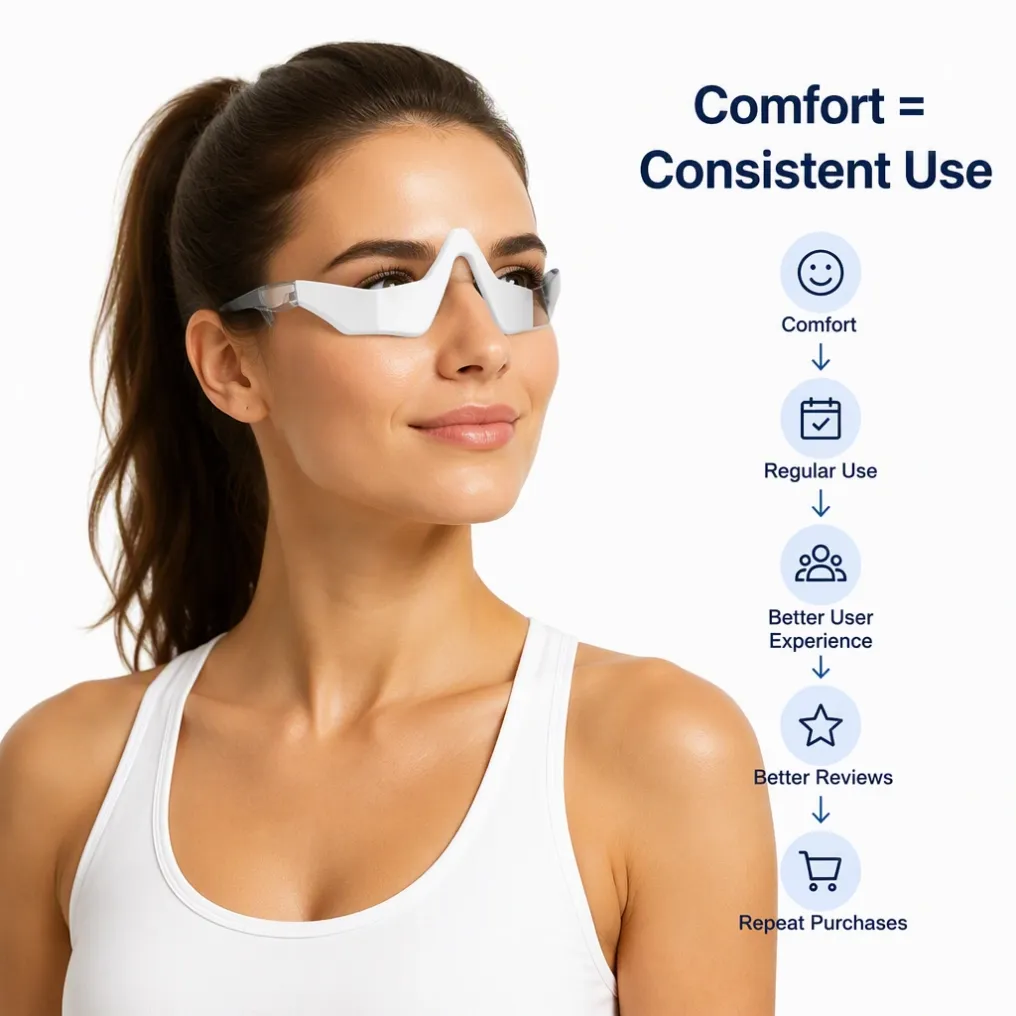
A device can have an impressive specification sheet, but if users find it uncomfortable, they may be less willing to incorporate it into a regular beauty routine.
This is especially important for home-use devices because results and user experience generally depend on following the recommended treatment routine consistently. In the broader home-use light-device category, experts similarly emphasize that the practical value of a device depends partly on whether users can use it consistently as directed.
4. The Buyer Noticed the Difference
After comparing our eye massager with alternatives from other manufacturers, the customer gave us an important piece of feedback:
“Your glasses are more comfortable. At the moment, the advantage is on your side.”
That comment matters to us more than simply winning on the number of functions.
Because it reflects something that is difficult to communicate on a specification sheet:
Comfort influences actual product use.
A comfortable device is easier to integrate into a regular routine.
Regular use can contribute to a better overall product experience.
A better experience can support stronger customer satisfaction, reviews and recommendations.
For beauty brands, those factors can ultimately matter more than having one additional LED color printed on the box.
5. Why We Focused on Red Light + EMS
Our design philosophy for this eye care device is therefore relatively simple:
Use the technologies that fit the target area—and make the device comfortable enough to use consistently.
The product combines red light with EMS microcurrent, rather than adding technologies simply to make the feature list longer.
Red-light LED technology has also been investigated specifically for the under-eye area. For example, a small 2024 study evaluated a commercial red/NIR LED under-eye device over six weeks; while its objective wrinkle-score change was not statistically significant, participants reported improvements across several under-eye appearance measures.
For us, this reinforces an important OEM development principle:
Technology selection should follow the intended application—not the other way around.
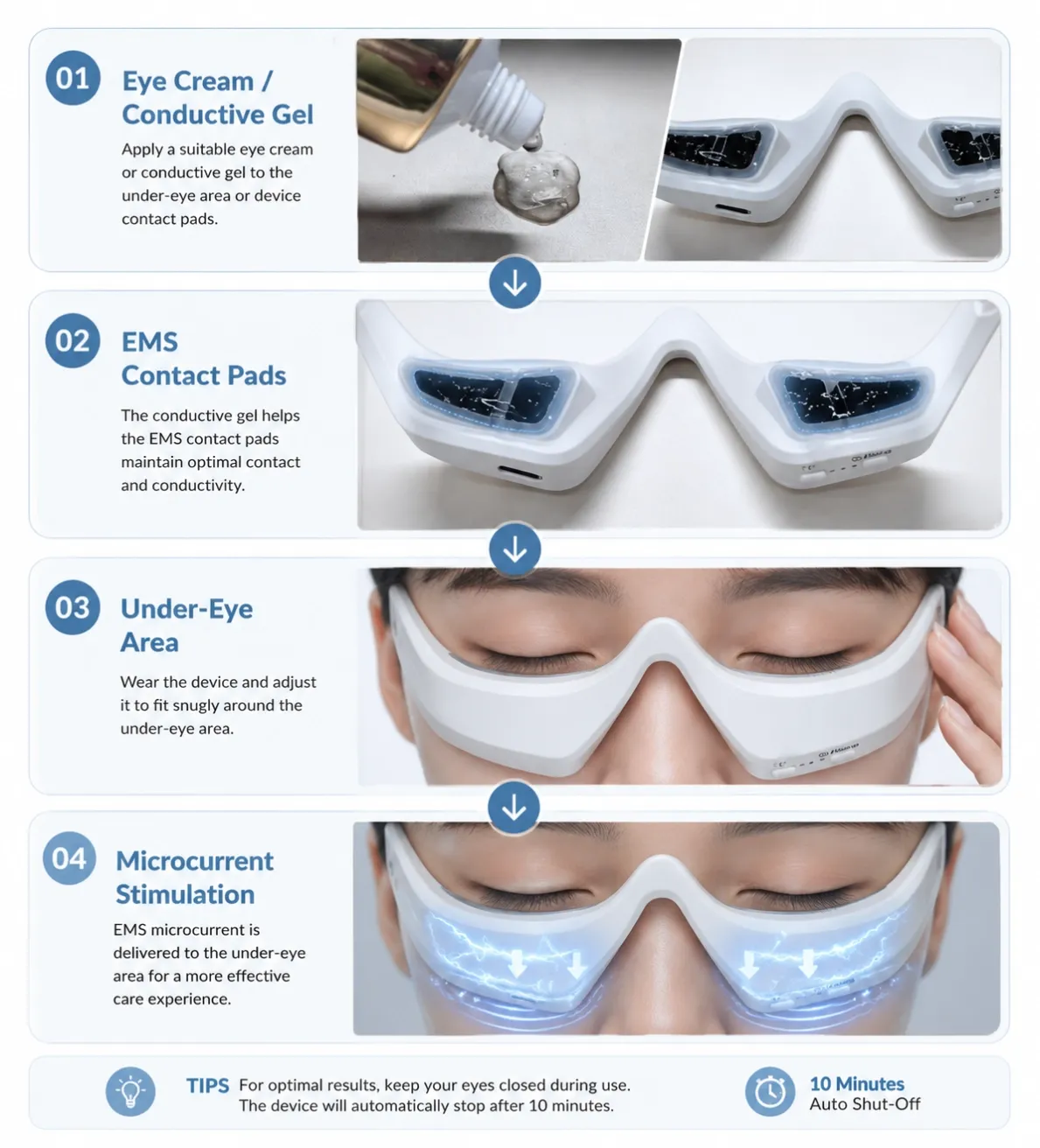
6. What Beauty Brands Should Compare Before Choosing an Eye Care Device
When sourcing an EMS eye massager or under-eye beauty device, don't compare suppliers only by counting functions.
Compare:
Function Relevance
Does each technology make sense for the target treatment area?
Wearing Comfort
Can consumers comfortably wear the product for the recommended session?
Skin Contact
Does the device maintain appropriate contact with the under-eye area?
Ergonomic Design
Has the product actually been designed around facial contours?
Ease of Use
Can consumers understand the controls without a complicated learning process?
Routine Compatibility
Is it convenient enough for regular home use?
OEM/ODM Potential
Can the product be adapted to the brand's positioning, logo, packaging and market strategy?
These questions tell a buyer much more than:
“How many functions does it have?”
More Features ≠ More Value
There will always be factories capable of adding another LED color, another vibration mode or another function.
And sometimes those additions genuinely improve the product.
But sometimes they simply make the specification sheet longer.
For an eye care device, we believe the better question is:
Does every feature solve a real user need—and will consumers actually want to keep using the device?
Our conversation with this customer started with a price comparison.
It ended with something much more valuable:
A discussion about product experience.
And after physically comparing the products, the customer's conclusion was that our device offered the better comfort.
That is exactly the kind of feedback we consider when developing home-use beauty technology.
Developing an OEM/ODM Eye Care Device?
Beautants works with beauty brands, distributors and private-label partners on home-use beauty device development and customization.
For eye care projects, we can discuss product configuration, branding, packaging and other OEM/ODM requirements based on your target market.
Looking for an EMS eye massager for your brand? Contact us to request product specifications or evaluate a sample.